Dried black fungus can look perfectly clean and shelf-stable, yet the moment it absorbs water, its handling requirements change. The safest approach is to use clean equipment, follow a controlled soaking method, avoid prolonged room-temperature exposure, and cook the rehydrated mushrooms appropriately. If soaking will take longer than two hours, Hong Kong’s Centre for Food Safety advises soaking mushrooms in the refrigerator rather than leaving them at room temperature. Rehydrated mushrooms should be used as soon as possible.
For food distributors, restaurant operators, and ingredient manufacturers, this is more than a kitchen detail. A dried ingredient may travel across borders and remain stable in its original packaging, but once water is introduced, storage conditions and handling practices become decisive.
How to Soak Dried Black Fungus Safely
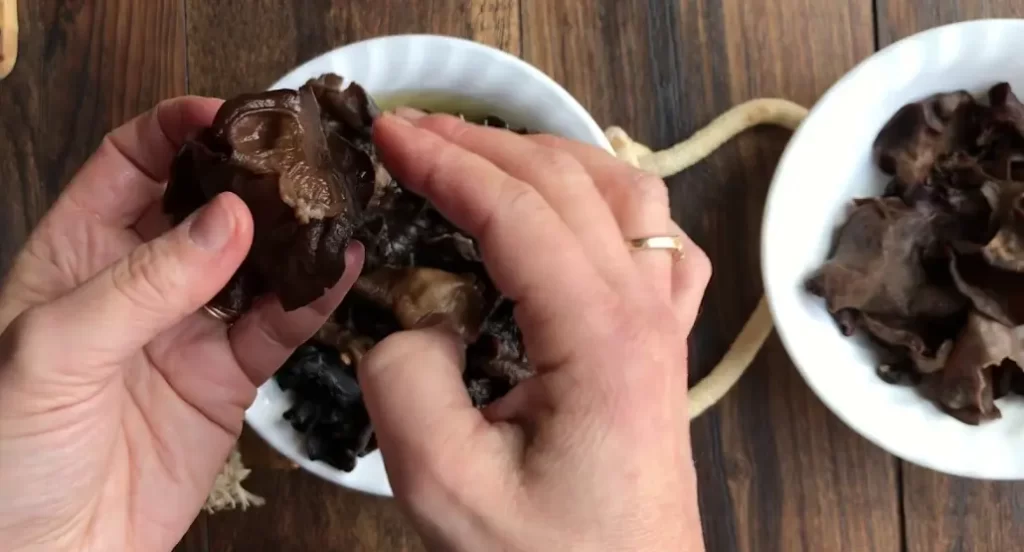
How to Soak Dried Black Fungus Safely
The goal is not simply to make the fungus soft. It is to rehydrate it without creating unnecessary opportunities for contamination or microbial growth.
Step 1: Inspect the Dried Mushrooms Before Soaking
Start with the package. Check the product identification, best-before date, storage instructions, and package integrity. Reject products with signs of moisture damage, unusual discoloration, visible mold, or evidence that the packaging has been compromised.
Do not assume that a dry appearance proves the product is pathogen-free. Drying restricts microbial growth by reducing available water, but some foodborne pathogens can survive in low-moisture foods. Research on dried mushrooms has demonstrated why subsequent handling still matters.
ScienceDirect
For commercial buyers, the inspection process should also connect the ingredient to its supplier, lot number, and applicable quality documentation. Traceability cannot make an unsafe product safe, but it helps a business identify and isolate affected batches when a problem arises.
Step 2: Prepare a Clean Soaking Environment
Wash your hands and use a clean, food-grade container. Make sure the container has no visible residue from previous food preparation, cleaning chemicals, or other ingredients.
Rinse the dried black fungus as appropriate to remove loose debris. Use clean, potable water for rehydration, and avoid containers that have been used for raw meat or unwashed produce without proper cleaning and sanitizing.
This step may appear routine. It is also where preventable handling errors begin. A safe ingredient can be contaminated by dirty hands, utensils, water, or work surfaces.
Step 3: Choose the Rehydration Method Carefully
Cold-water soaking and hot-water rehydration are not interchangeable in every situation. The appropriate method depends on the product instructions, intended culinary use, and the food-safety procedure being followed.
The U.S. Food and Drug Administration recommended boiling-water rehydration in its guidance concerning the 2020 dried wood ear mushroom outbreak. That recommendation should be understood in context: applying hot water is not a universal guarantee of pathogen elimination, nor does it replace appropriate cooking and hygienic handling.
FDA +1
Follow the package instructions where available, and do not substitute an improvised soaking method for a validated commercial process.
Step 4: Control Soaking Time and Temperature
There is no single soaking duration that fits every dried black fungus product. Thickness, size, drying conditions, and the manufacturer’s preparation instructions can all affect how quickly the fungus rehydrates. A fixed time copied from a recipe should never override food-safety requirements.
The more important distinction is between the time needed to soften the product and the time it remains in water before cooking. One is a preparation consideration; the other is a food-safety concern.
Preparation and Handling Factors
| Preparation Factor | What to Check | Recommended Handling Approach | Common Mistake |
|---|---|---|---|
| Water quality | Potability and cleanliness | Use clean, potable water | Assuming clear water is necessarily safe |
| Container hygiene | Food-contact surfaces | Clean and sanitize according to the applicable procedure | Reusing a contaminated container |
| Soaking temperature | Room temperature versus refrigeration | Refrigerate if soaking will exceed two hours | Leaving fungus soaking overnight on the counter |
| Rehydration time | Product thickness and package directions | Follow product-specific instructions and inspect texture | Assuming every batch needs the same duration |
| Batch size | Quantity needed for immediate use | Prepare manageable quantities | Rehydrating more than can be handled safely |
| Subsequent cooking | Intended dish and validated process | Cook appropriately before serving | Treating soaking as equivalent to cooking |
The two-hour limit above reflects Hong Kong Centre for Food Safety guidance for room-temperature soaking. It is not a universal shelf-life limit, and stricter applicable food-safety requirements take precedence.
Step 5: Drain, Inspect, and Prepare for Cooking
Once the fungus has rehydrated, drain it and inspect the pieces. Remove hard or undesirable sections where appropriate, and rinse again if needed to remove residual debris.
Discard the batch if it has developed a slimy surface, an abnormal smell, or other signs of spoilage. Do not taste questionable food to determine whether it is safe.
Appearance alone cannot establish microbiological safety. If the soaking history is unknown, the product has been left under unsuitable conditions, or the handling record is unreliable, do not rely on smell or texture to justify using it.
How Long Should Dried Black Fungus Soak?
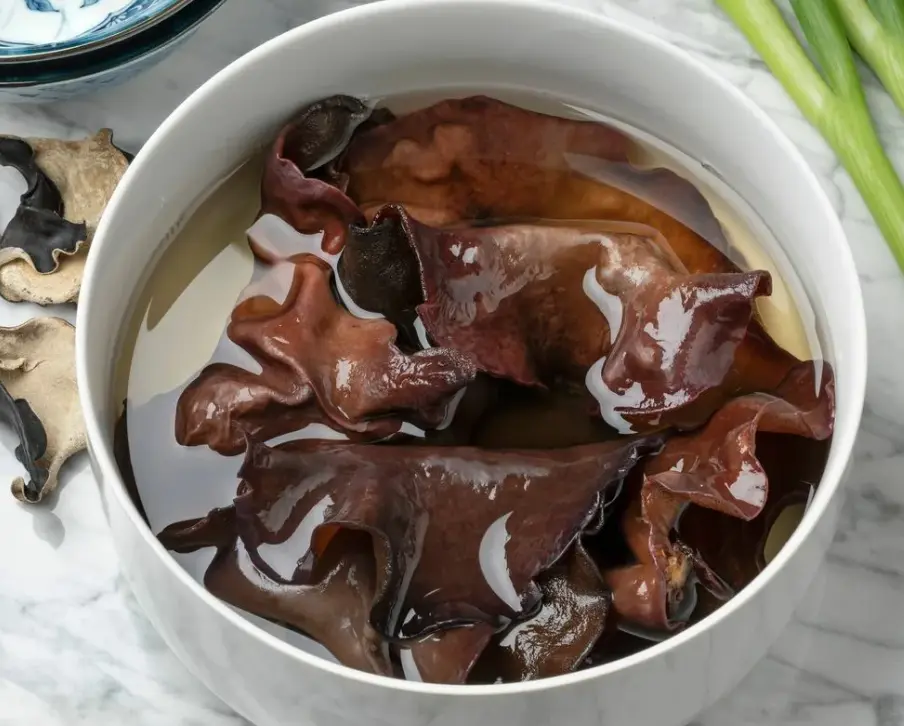
How Long Should Dried Black Fungus Soak?
Soaking duration depends on the product, not simply the name printed on the package. Thin pieces may rehydrate faster than thick, curled pieces, while different drying processes can affect the resulting texture.
For commercial kitchens, the practical objective is to establish a repeatable preparation procedure that produces the required texture while keeping time and temperature under control.
According to the Centre for Food Safety’s published mushroom-handling advice, prolonged soaking should take place under refrigeration, and soaked mushrooms should be used as soon as possible.
香港食物安全中心
Can You Soak Black Fungus Overnight?
Overnight preparation should not mean leaving a bowl of mushrooms at room temperature until morning. If advance preparation is necessary, use refrigeration throughout the extended soaking period, keep the container clean and covered, and follow the product’s instructions.
Refrigeration slows the growth of many microorganisms, but it does not sterilize food or eliminate every pathogen. Nor does refrigeration correct unsafe handling that occurred earlier.
Based on our experience with food ingredient supply-chain requirements, consistency is often more useful than relying on a single soaking time copied from a recipe. Commercial operators should document the preparation method, control the holding conditions, and prepare quantities that can be used promptly.
How Long Can Rehydrated Black Fungus Be Stored?
This is the question that deserves the most careful answer. There is no universally validated storage duration that can be applied to every batch of rehydrated black fungus.
Storage safety depends on the initial microbial load, water quality, handling hygiene, soaking conditions, refrigeration, and the time elapsed before the product is used. A laboratory study under controlled conditions cannot automatically establish a safe storage period for every commercial product or domestic refrigerator.
The following table provides a practical decision framework rather than an invented shelf-life specification.
Rehydrated Black Fungus Storage Decision Framework
| Situation | Main Risk or Consideration | Recommended Decision |
|---|---|---|
| Newly rehydrated, handled hygienically | Further microbial growth remains possible | Use as soon as possible |
| Soaking continues beyond two hours | Extended room-temperature exposure | Refrigerate for prolonged soaking |
| Rehydrated and held under refrigeration | Growth may be slowed but not eliminated | Follow applicable guidance and the established holding procedure |
| Left at room temperature for an extended or unknown period | Temperature history may be unsafe | Do not assume refrigeration afterward makes it safe |
| Slimy, unusually odorous, or visibly spoiled | Possible spoilage or deterioration | Discard without tasting |
| Commercial batch with incomplete time-temperature records | Safety cannot be reliably assessed | Hold and assess under the site’s food-safety procedure; discard if safety cannot be established |
This table is a handling decision aid, not a validated shelf-life study. The two-hour reference applies to room-temperature soaking guidance, not to a universal rule for all post-soaking storage.
Why Dried Mushrooms Can Still Present a Food-Safety Risk
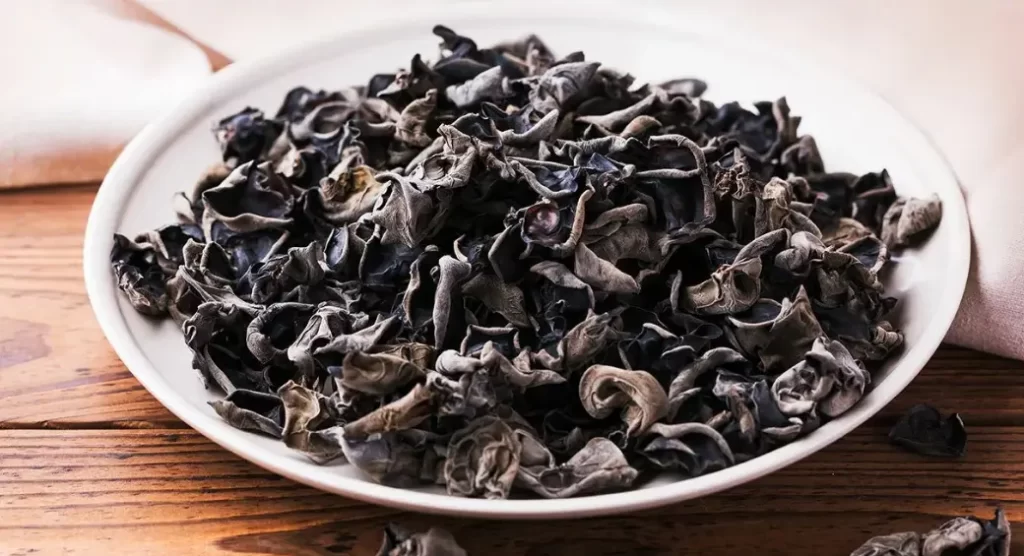
Why Dried Mushrooms Can Still Present a Food-Safety Risk
The critical scientific distinction is between microbial growth and microbial survival. Low water activity can prevent many microorganisms from multiplying while the product remains dry, yet some pathogens may survive and become relevant again after water is introduced.
Research on rehydrated wood ear mushrooms has investigated the behavior of Salmonella enterica and Listeria monocytogenes under specific experimental conditions. These findings reinforce the need for controlled preparation, but they should not be simplified into a claim that every rehydrated batch becomes unsafe after a particular number of hours or days.
For wholesalers and food manufacturers, the operational response is straightforward: preserve traceability, establish documented preparation and holding procedures, monitor refrigeration, and validate any proposed storage period for the actual product and process.
Food Safety Risks of Rehydrating Dried Black Fungus
A dried ingredient can pass a visual inspection and still require careful handling. For buyers managing multiple suppliers, production lines, or restaurant locations, the challenge is not merely preventing visible spoilage. It is controlling hazards that cannot reliably be detected by sight or smell.
Can Bacteria Survive on Dried Black Fungus?
Yes. Drying reduces available water and restricts microbial growth, but it does not necessarily destroy every foodborne pathogen. Once water is added, the product’s conditions change, and the potential for microbial growth depends on the organism, temperature, time, and other environmental factors.
The 2020 U.S. outbreak associated with dried wood ear mushrooms illustrates why this distinction matters. The FDA investigated a Salmonella outbreak linked to dried wood ear mushrooms and issued product-specific safety guidance. This is a documented example, not evidence that all dried black fungus products are contaminated.
For importers and food processors, the lesson is clear: assess the product’s safety controls before it reaches the preparation area, then maintain those controls throughout rehydration and subsequent handling.
Does Boiling Water Make Black Fungus Completely Safe?
Boiling-water rehydration can form part of an appropriate preparation method, and the FDA recommended it in the context of the 2020 outbreak. However, hot water should not be treated as a universal sterilization step. Its effect depends on the actual temperature, exposure, product characteristics, and the microorganisms involved.
Use the manufacturer’s preparation instructions and a validated cooking procedure appropriate to the intended food. Avoid making unsupported claims that a particular soaking method eliminates every pathogen.
Quality Assurance: How to Handle Rehydrated Black Fungus Consistently
For commercial buyers, quality assurance starts before soaking. A supplier’s documentation, the condition of the incoming product, and the consistency of preparation procedures all contribute to the overall control system.
Based on our experience with food ingredient supply-chain requirements, a useful quality assurance plan should distinguish product quality from food safety. Appearance, aroma, and texture are important quality attributes, but none independently demonstrates microbiological safety.
The following framework can help procurement teams, quality managers, and food-service operators assess the process.
Quality Assurance Checklist for Rehydrated Black Fungus
| Quality Assurance Dimension | What to Verify | Evidence or Record | Corrective Action |
|---|---|---|---|
| Supplier approval | Supplier identity and applicable food-safety documentation | Approved supplier records | Escalate missing or inconsistent documentation |
| Incoming product | Package integrity, labeling, lot identification, and visible condition | Receiving inspection record | Segregate questionable lots |
| Water and equipment | Potable water and hygienic food-contact surfaces | Sanitation and water-control records | Clean, sanitize, or investigate water quality |
| Rehydration | Approved method and controlled time-temperature conditions | Preparation log | Stop use and assess deviations |
| Refrigerated holding | Appropriate refrigeration and traceable holding time | Temperature and batch records | Follow the corrective-action procedure |
| Cooking and service | Compliance with the applicable validated process | Cooking or production records | Hold affected food pending assessment |
| Traceability | Ability to connect prepared batches to incoming lots | Lot and batch records | Isolate potentially affected batches |
This table is a general operational framework, not a claim that every listed step is a critical control point under every HACCP plan. Each food business must determine its hazards and controls according to its actual process and applicable requirements.
Supplier Traceability and Incoming Inspection
For a global food buyer, traceability should connect the delivered product to a supplier, product specification, and identifiable lot. Where applicable, request relevant food-safety documentation and test reports, and verify that they match the product being purchased.
WUSANGONG’s product and quality pages can serve as starting points for buyers evaluating its edible mushroom range and available quality information. Buyers should confirm current product-specific specifications and documentation directly rather than assuming that a general company certification covers every batch or intended use.
A dependable supplier relationship also requires clear communication about packaging integrity, storage instructions, lot identification, and how quality concerns are handled.
Safe Handling Procedures for Restaurants and Food Manufacturers
Commercial kitchens face a different challenge from household users: they may soak several batches simultaneously, prepare ingredients in advance, and transfer rehydrated mushrooms between storage and production areas.
A written procedure helps reduce variation between shifts and locations.
Establish a Repeatable Batch-Preparation Workflow
- Inspect: Confirm the incoming product’s identity, lot number, package condition, and preparation instructions.
- Prepare: Clean and sanitize equipment according to the site’s established sanitation procedure.
- Rehydrate: Use potable water and follow the approved method, controlling soaking time and temperature.
- Record: Identify the batch and document the relevant preparation and holding information.
- Use promptly: Minimize unnecessary holding and prevent cross-contamination during subsequent preparation.
- Escalate deviations: Hold affected batches when their handling history raises a safety concern, and follow documented corrective actions.
For large-scale operations, the objective is not simply to prepare black fungus faster. It is to make the process reproducible, traceable, and suitable for verification during internal audits.
What Buyers Should Request from a Dried Black Fungus Supplier
Before placing a bulk order, procurement teams should establish whether the supplier can provide the documentation required for their destination market and intended application.
Useful items to verify include:
- Product specifications and identification of the supplied mushroom.
- Applicable food-safety management documentation.
- Lot identification and traceability arrangements.
- Relevant test reports and their scope.
- Packaging specifications and storage instructions.
- Procedures for addressing nonconforming products or complaints.
These checks are particularly important when rehydrated wood ear mushrooms will enter ready-meal production, food-service operations, or other processes where many servings are prepared from a single batch.
Frequently Asked Questions About Soaking and Storing Black Fungus
1. Can You Soak Dried Black Fungus Overnight in the Refrigerator?
Extended soaking should take place in the refrigerator rather than at room temperature. Use a clean, covered container and follow the product’s preparation instructions. Refrigeration slows the growth of many microorganisms but does not guarantee safety indefinitely. Use the rehydrated mushrooms as soon as possible.
2. How Long Can Rehydrated Black Fungus Be Stored in the Fridge?
There is no universally validated storage duration for every rehydrated black fungus product and handling condition. Follow applicable food-safety guidance and the product-specific holding procedure. For commercial operations, establish and validate an appropriate holding period rather than adopting an unsupported number of days.
3. Is Boiling Water Safer Than Cold Water for Rehydrating Wood Ear Mushrooms?
The FDA recommended boiling-water rehydration in its guidance concerning the 2020 dried wood ear mushroom outbreak. However, hot-water treatment is not a universal guarantee against foodborne pathogens. Follow the manufacturer’s instructions and an appropriate cooking procedure, while maintaining hygienic handling throughout preparation.
4. How Can You Tell If Rehydrated Black Fungus Has Gone Bad?
Discard mushrooms that develop slime, an abnormal odor, visible mold, or other clear signs of deterioration. However, the absence of these signs does not prove that the product is safe. If the soaking duration, temperature history, or handling conditions are unknown, do not rely on appearance or smell to justify consumption.
5. What Should Food Manufacturers Check Before Buying Dried Black Fungus in Bulk?
Buyers should evaluate supplier documentation, product specifications, packaging integrity, lot traceability, relevant testing, and storage instructions. They should also establish documented procedures for rehydration, refrigeration, cooking, and batch handling. Supplier approval and incoming inspection should form part of a broader food-safety system rather than serve as substitutes for process controls.
Expert Verdict: Control the Process, Not Just the Soaking Time
Safe black fungus preparation depends on more than choosing hot or cold water. Inspect the dried product, use hygienic equipment, control soaking time and temperature, refrigerate when extended soaking is necessary, and use rehydrated mushrooms promptly.
For global buyers, consistent supplier documentation and validated handling procedures are the foundation of a reliable ingredient program. A good-looking batch is not proof of safety, and a longer shelf life should never be assumed without supporting evidence.