The dried mushrooms wholesale price is rarely determined by mushroom species alone. For a serious B2B purchase, a more useful benchmark is product specification + origin + processing + food-safety documentation + trade terms. Current international market references show why a single price per kilogram can be misleading: CBI previously reported an average China-origin dried shiitake export price of around €15/kg in 2022, while more recent market data shows materially different wholesale price signals depending on market and product specification.
Price Factors B2B Buyers Should Consider
| Price Variable | What the Buyer Should Specify | Typical Commercial Impact |
|---|---|---|
| Species | Lentinula edodes, black fungus, etc. | High |
| Grade | Standard, premium, flower-grade | High |
| Size | Cap diameter and thickness | Medium–High |
| Product form | Whole, sliced, broken pieces | Medium |
| Origin | Generic China vs verified Qingyuan origin | Medium–High |
| Moisture | Contractual moisture specification | Medium |
| Drying | Sun-dried, machine-dried or combined process | Medium |
| Testing | Pesticide, heavy metals, microbiology | Medium |
| Packaging | Bulk industrial or private label | Medium–High |
| MOQ | Trial order vs container volume | Can reduce unit cost |
| Incoterm | EXW, FOB, CIF | Directly affects landed cost |
The real problem appears when a purchasing manager receives three quotations that look comparable but are not. One supplier may quote whole, thick-cap shiitake with controlled moisture and batch testing; another may offer smaller mushrooms with a higher broken percentage; a third may quote an attractive FOB price but provide less comprehensive documentation. Based on our experience with international mushroom supply, the cheapest quotation is often not the cheapest usable ingredient. For supermarket chains and food manufacturers, inconsistency creates costs later through rejected batches, sorting losses, reformulation and additional inspection.
Why Dried Mushroom Wholesale Prices Vary So Widely
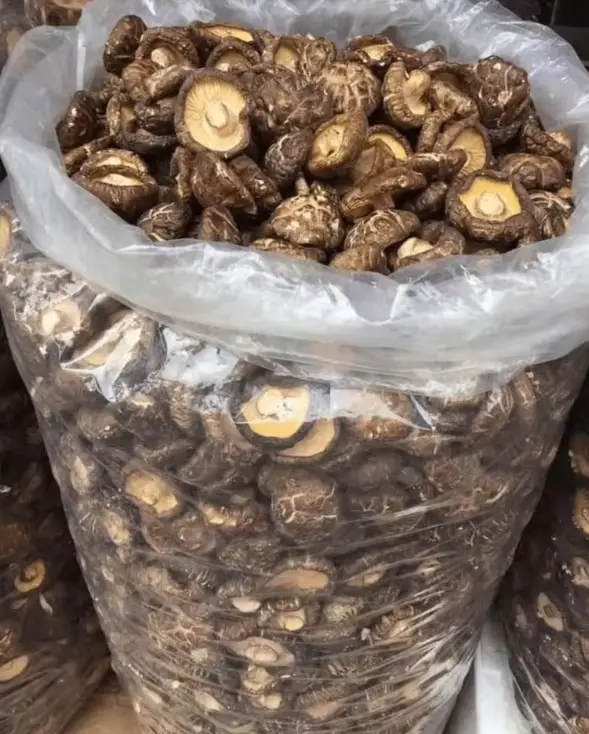
Why Dried Mushroom Wholesale Prices Vary So Widely
A wholesale quotation should begin with a product specification, not with a number. This is particularly important for bulk dried mushrooms, where seemingly minor differences in grade can change both yield and commercial value.
1. Mushroom Grade Changes the Economics
For dried shiitake, buyers should look beyond the label “premium.” Ask how the supplier defines premium.
Relevant parameters include:
- Cap diameter
- Cap thickness
- Shape and uniformity
- Color
- Aroma intensity
- Stem proportion
- Broken-mushroom percentage
- Insect damage
- Foreign matter
- Moisture
- Rehydration performance
A restaurant distributor may prefer attractive whole caps because appearance affects menu presentation. A food-processing factory may have the opposite priority and obtain better economics from sliced mushrooms or smaller pieces. An extraction or seasoning manufacturer may care more about raw-material consistency than visual appearance.
That is why a dried shiitake wholesale price should always be evaluated against the buyer’s actual application.
2. Origin Is More Than a Marketing Statement
Origin becomes particularly relevant when buyers compare Chinese dried shiitake suppliers.
Qingyuan, Zhejiang, has a long-established shiitake cultivation tradition and is associated with a protected geographical-indication framework. China’s national standards database lists GB/T 19087-2008, Product of Geographical Indication — Qingyuan Xiang Gu, covering product requirements as well as testing, marking, packaging, transportation and storage.
This distinction matters.
“Made in China” is a country-of-origin statement. “Qingyuan-origin shiitake” carries a much more specific geographical meaning and should be supported by appropriate production-area and traceability evidence. A buyer should therefore ask not simply “Where was this mushroom packed?”, but “Where was the raw mushroom cultivated, and can that origin be traced through the supply chain?”
For a Qingyuan dried shiitake supplier, origin verification should sit alongside quality testing rather than replace it. Geography contributes to product identity; it does not eliminate the need for food-safety controls.
3. Drying Method Influences Consistency, Not Just Flavor
Traditional sun drying and controlled mechanical drying are often presented as competing methods. In commercial production, the reality is more nuanced.
Sun drying can contribute traditional sensory characteristics and uses natural solar energy, but drying conditions depend heavily on weather, humidity and exposure time. Mechanical drying provides tighter control over temperature, airflow and drying time, making it easier to achieve repeatable commercial specifications.
Sun Drying vs. Controlled Mechanical Drying
| Factor | Traditional Sun Drying | Controlled Mechanical Drying | B2B Purchasing Consideration |
|---|---|---|---|
| Energy source | Solar/natural | Electricity or thermal energy | Consider total energy footprint |
| Temperature control | Limited | Precise | Important for consistency |
| Drying uniformity | Weather dependent | Highly controllable | Important for bulk orders |
| Aroma profile | Traditional sensory character | More standardized | Evaluate by application |
| Production continuity | Seasonal/weather dependent | More predictable | Important for annual contracts |
| Industrial scalability | Moderate | High | Important for large-volume buyers |
| Moisture consistency | Requires additional control | Easier to standardize | Direct quality concern |
| Sustainability | Potentially favorable | Depends on energy source | Assess actual process |
The correct procurement question is therefore not “Which drying method is always better?” It is:
Does the drying process consistently deliver the moisture, color, aroma, texture and microbiological specifications required by the buyer?
For a food manufacturer purchasing several tons per year, repeatability normally matters more than the processing label itself.
How to Read a Dried Mushroom Price Quotation
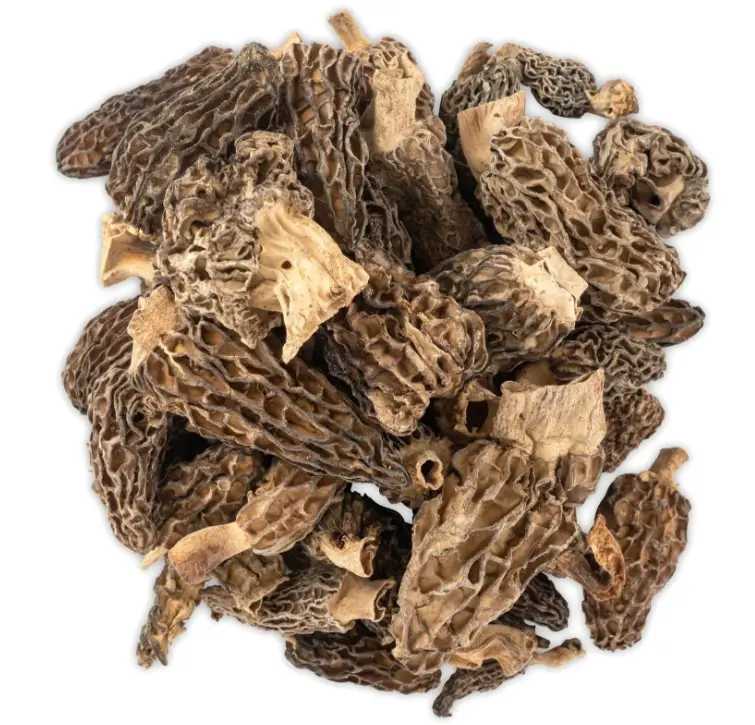
How to Read a Dried Mushroom Price Quotation
Before comparing suppliers, normalize every quotation into the same commercial format:
Species → Grade → Size → Form → Moisture → Origin → Drying → Testing → Packaging → MOQ → Incoterm → Destination
This prevents a common purchasing mistake: comparing a low-grade commodity quotation with a premium-origin product and treating the difference as supplier markup.
For example, a food processor buying sliced mushrooms for soup production may not benefit from paying premium pricing for visually perfect whole caps. Conversely, a supermarket private-label buyer may find that purchasing cheaper broken pieces creates unacceptable packaging and consumer-perception problems.
A professional dried mushrooms wholesale price comparison therefore starts with the end use.
What Jiangyuan’s Integrated Supply Chain Changes
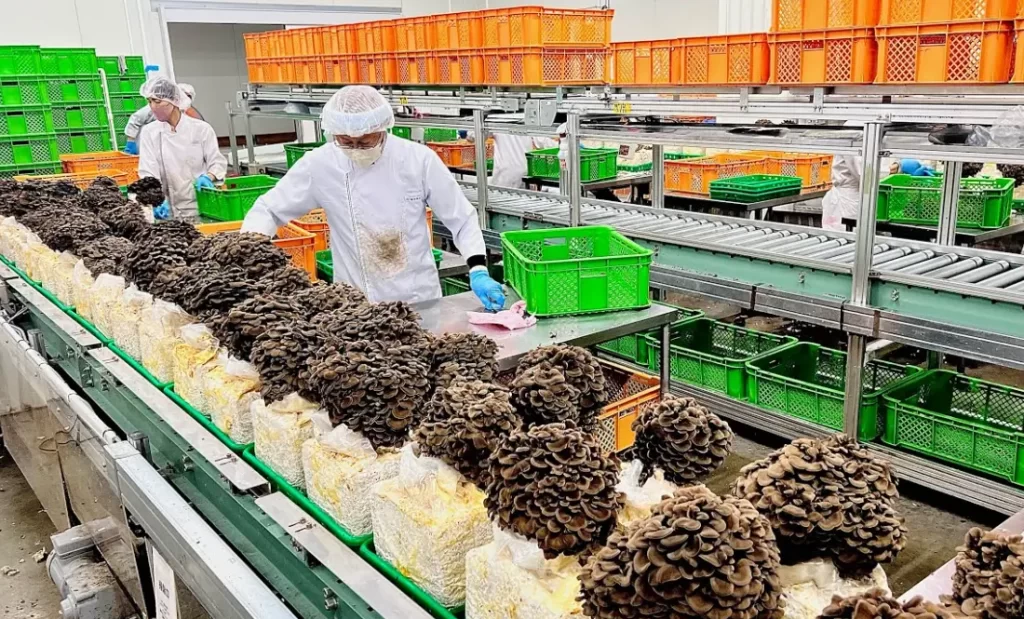
What Jiangyuan’s Integrated Supply Chain Changes
Jiangyuan Mushroom’s supply model is structured around the chain of raw mushroom selection → cleaning and sorting → grading → drying → quality inspection → packaging → export shipment. The practical advantage for B2B buyers is not simply “factory direct” pricing. It is the ability to connect product specifications with production and quality-control decisions at each stage.
For international buyers, that connection matters when a quotation needs to be repeated six months later.
A supplier who can explain why a batch is priced differently — and provide the corresponding grade, processing and testing information — is generally more useful than one offering only a low headline number.
How to Build a Reliable Quality Assurance System for Bulk Dried Mushrooms
A competitive quotation means little if the supplier cannot maintain the same specification from one shipment to the next. For global food wholesalers, supermarket chains and ingredient manufacturers, quality assurance should therefore be evaluated alongside the dried mushrooms wholesale price. The practical objective is simple: every commercial batch should match the agreed specification, remain traceable to its source, and carry documentation that supports the destination market.
What B2B Buyers Should Request Before Placing a Bulk Order
A supplier quotation should be followed by a technical specification sheet and, where applicable, a batch-level Certificate of Analysis (COA). Buyers should define acceptance criteria before production rather than negotiating them after the goods arrive.
Bulk Dried Mushroom Quality Assurance Checklist
| Quality Parameter | What to Verify | Why It Matters | Recommended Buyer Action |
|---|---|---|---|
| Species | Lentinula edodes or specified species | Prevents product substitution | Require species identification |
| Origin | Cultivation and processing location | Supports authenticity and traceability | Request origin documentation |
| Grade | Size, cap thickness, appearance | Determines yield and market value | Put grade in the purchase contract |
| Moisture | Agreed contractual specification | Affects storage stability and weight | Verify by batch |
| Foreign matter | Physical inspection result | Protects food safety and processing efficiency | Define maximum tolerance |
| Pesticide residues | Multi-residue laboratory report | Supports market compliance | Match testing to destination |
| Heavy metals | Cadmium, lead and other applicable contaminants | Important for regulatory compliance | Request recent test results |
| Microbiology | Relevant pathogen and hygiene indicators | Reduces contamination risk | Require appropriate COA |
| Packaging | Material, net weight and sealing | Protects product during transport | Approve packaging specification |
| Traceability | Batch/lot identification | Enables investigation and recall | Require lot coding |
For European buyers, pesticide compliance should be assessed against the EU maximum residue level framework under Regulation (EC) No. 396/2005. For US buyers, terminology also matters: FDA does not generally “approve” food products before import; compliance depends on applicable food-safety requirements and controls.
Heavy metals deserve separate attention. EU Regulation 2023/915 establishes maximum levels for contaminants in food, and subsequent amendments include provisions relevant to cadmium in cultivated fungi.
That is why a credible dried mushroom manufacturer should be able to discuss test parameters in practical terms instead of simply displaying a collection of certificates.
How to Calculate the Real Cost of Bulk Dried Mushrooms
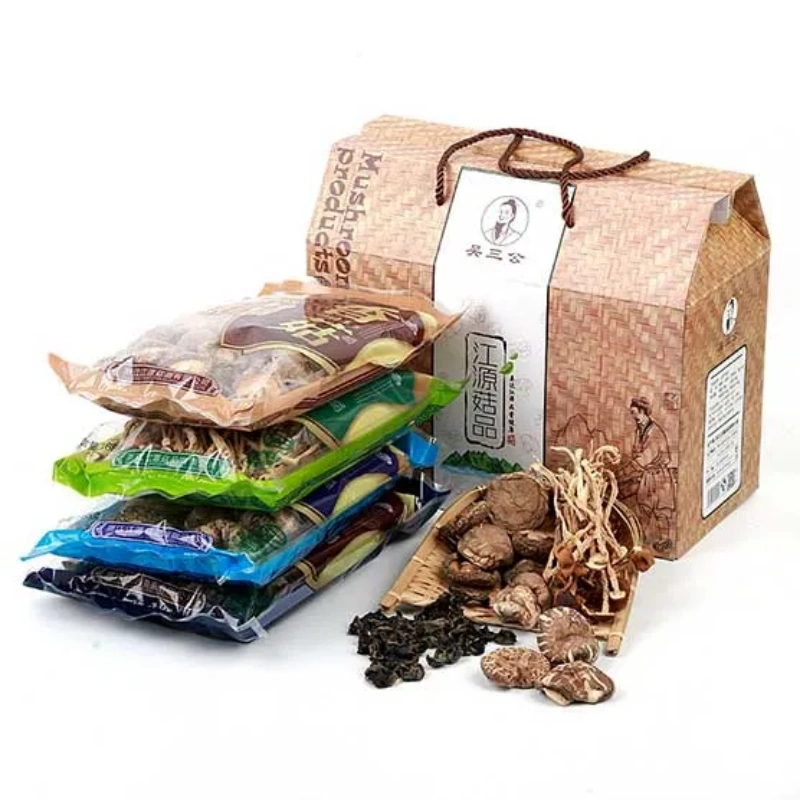
How to Calculate the Real Cost of Bulk Dried Mushrooms
The supplier’s quoted kilogram price is only one component of procurement cost. A buyer importing from China should distinguish between product price and landed cost.
Landed Cost Calculation
Landed Cost/kg = Product Price + Packaging + Inland Freight + Export Charges + International Freight + Insurance + Import Costs + Local Delivery
This distinction becomes important when comparing EXW, FOB and CIF quotations.
An apparently cheaper EXW offer may become less attractive after arranging factory pickup, export handling and freight. Conversely, a higher CIF quotation may include transportation costs that make budgeting easier.
For annual purchasing, the calculation should go one step further:
Effective Procurement Cost
Effective Cost = Purchase Cost + Quality Loss + Sorting Loss + Freight + Inspection + Storage + Rejection Risk
This is where consistent quality can justify a slightly higher purchase price. If a food processor loses several percentage points of usable material because of excessive breakage, inconsistent moisture or poor sorting, the nominal saving disappears quickly.
Choosing the Right Product for the Application
Not every buyer needs the same grade. Product selection should begin with the manufacturing or sales application.
Supermarket and retail buyers generally place greater emphasis on whole-mushroom appearance, uniformity, aroma, packaging presentation and origin claims.
Restaurant distributors may prioritize whole or medium-sized dried shiitake with reliable rehydration characteristics and strong aroma.
Food manufacturers often benefit from sliced mushrooms, smaller grades or controlled pieces because appearance is less important than ingredient consistency and processing efficiency.
Seasoning, soup-base and extraction manufacturers may have different raw-material requirements again, making broken pieces or specific size fractions commercially attractive.
The best supplier is therefore not necessarily the one offering the lowest dried mushrooms wholesale price. The supplier capable of matching the raw material to the buyer’s production process is the more appropriate choice.
How Jiangyuan Mushroom Approaches B2B Quality Control
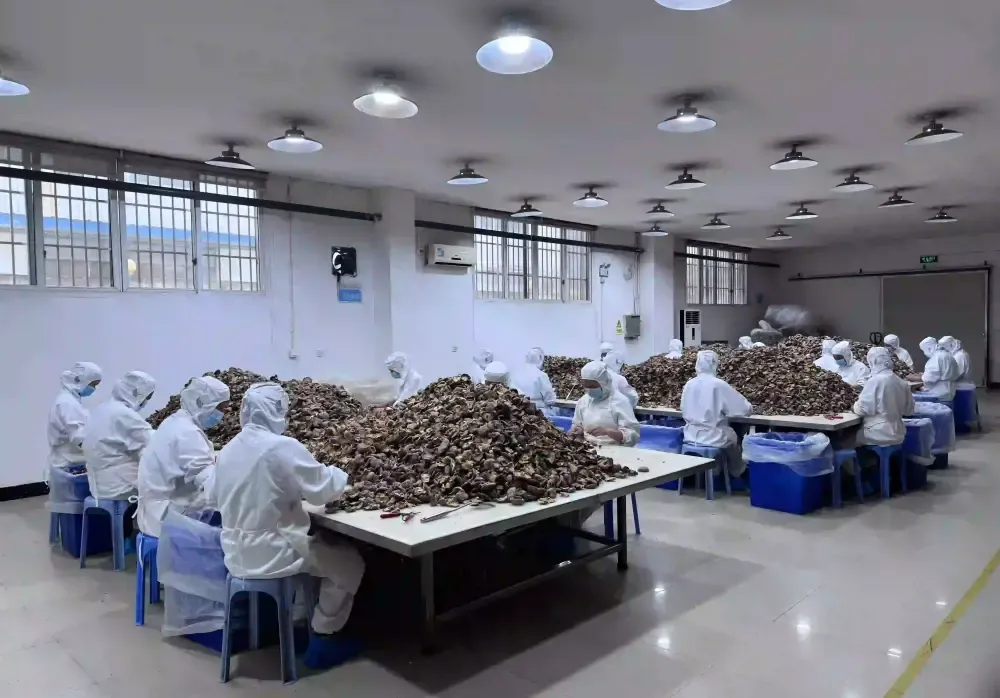
How Jiangyuan Mushroom Approaches B2B Quality Control
Based on our experience with long-term mushroom supply, the most effective quality system begins before drying. Raw mushrooms need to be selected and sorted according to the final product specification. Drying then has to deliver predictable moisture and physical characteristics, followed by grading, inspection and controlled packaging.
For Jiangyuan Mushroom, the production chain can be viewed as:
Raw Mushroom Selection → Cleaning & Sorting → Grading → Drying → Quality Inspection → Packaging → Export
This structure matters because traceability is more useful when it connects several production stages rather than functioning only as a lot number printed on a bag.
The same principle applies to origin. Qingyuan has a documented shiitake cultivation tradition and a geographical-indication standard, but responsible sourcing requires distinguishing between a general Chinese-origin claim and a substantiated Qingyuan-origin claim.
For an international buyer, that distinction provides a practical verification point: ask where the mushrooms were cultivated, where they were processed, and whether the relevant records can be connected to the finished batch.
Factory-Direct Supply, OEM and Long-Term Purchasing
For buyers ordering repeatedly, the commercial relationship matters as much as the first quotation. A manufacturer with integrated sourcing and processing capabilities can potentially coordinate grade selection, drying, bulk packaging and private-label requirements within one supply chain.
Jiangyuan’s product formats can be matched to different B2B applications, including:
- Whole dried shiitake for retail and foodservice
- Sliced dried shiitake for food manufacturing
- Smaller mushrooms for ingredient applications
- Broken pieces for soup, seasoning and processing
- Customized bulk or retail packaging
- Private-label mushroom products
For supermarket groups and branded food companies, OEM capability is particularly useful because the procurement specification can combine product grade + packaging + labeling + testing + shipment schedule instead of treating these as separate projects.
5 FAQs Global Buyers Ask Before Importing Dried Mushrooms
1. What Is a Reasonable Dried Mushrooms Wholesale Price per kg?
There is no reliable universal price. A valid comparison must specify mushroom species, grade, size, moisture, processing method, packaging, MOQ and Incoterm. Current market references demonstrate substantial variation between origins and product specifications.
2. What Tests Should I Request from a Chinese Dried Mushroom Supplier?
For most professional procurement programs, buyers should consider pesticide-residue testing, heavy-metal testing, microbiological testing and moisture verification, with the exact testing panel determined by the destination market and product specification.
3. How Can I Verify Whether Qingyuan Dried Shiitake Is Genuinely from Qingyuan?
Ask for cultivation-origin information, traceability records and documentation supporting any geographical-indication claim. Do not treat the location of final packaging as proof of cultivation origin.
4. Are Sun-Dried Mushrooms Better Than Machine-Dried Mushrooms?
Neither method should automatically be considered superior. Sun drying may provide traditional sensory characteristics, while controlled mechanical drying generally offers better process consistency. Buyers should compare the finished mushroom’s aroma, moisture, color, texture and microbiological results.
5. How Do I Compare Two Dried Mushroom Suppliers Fairly?
Give both suppliers exactly the same RFQ specification: species, origin, grade, size, whole/sliced ratio, moisture, testing requirements, packaging, MOQ, Incoterm and destination. Then compare the landed cost and usable yield, not just the quoted price per kilogram.
Expert Verdict
For global B2B buyers, price should be the starting figure — not the final decision.
A dependable dried mushroom program is built around verified origin, defined grade, controlled drying, measurable food-safety specifications, traceability and repeatable supply. If two quotations are not based on the same specification, they are not genuinely comparable.
For long-term procurement, choose the supplier that can prove what is inside the quotation — and deliver the same standard again.
Please note that dried mushroom wholesale prices are subject to change depending on raw material availability, harvest seasons, product grades, moisture specifications, processing costs, order quantities, packaging requirements, exchange rates and international freight charges. Any prices or market references mentioned in this article are for general informational and purchasing guidance only and should not be considered fixed quotations. For an accurate and up-to-date quotation, buyers are encouraged to confirm product specifications, order quantities, destination markets and Incoterms directly with the supplier before placing an order.
References:
FAO / WHO – Standard for Dried Edible Fungi (CXS 39-1981)
Cornell University – Storage & Preservation: Drying Shiitake Mushrooms