Choosing an OEM mushroom packaging manufacturer in China involves more than finding a factory that can print a logo on a pouch. For food wholesalers, supermarket buyers, and ingredient processors, the real challenge is finding a partner that understands both the mushroom product and the packaging system protecting it. The right solution must match the product format, storage conditions, distribution route, branding requirements, and destination-market regulations.
For WUSANGONG, this distinction matters. Its mushroom sourcing and processing expertise provides a foundation for customized mushroom products, while the exact scope of packaging production and customization must be confirmed for each project.
| Buyer requirement | What to evaluate | Why it matters |
|---|---|---|
| Product compatibility | Dried, fresh, sliced, or powdered mushrooms | Each format has different protection and handling needs |
| Packaging performance | Moisture barrier, oxygen barrier, and seal integrity | Helps preserve product quality during storage and transport |
| Branding | Printed pouches, labels, cartons, and pack sizes | Supports retail presentation and private-label consistency |
| Compliance | Food-contact documentation and destination-market requirements | Reduces regulatory and import risks |
| Commercial feasibility | Product MOQ, packaging MOQ, setup costs, and lead time | Helps control the total cost of an OEM project |
The strongest supplier is not necessarily the one offering the lowest initial quotation. It is the one that can explain its production scope, document its specifications, and maintain consistent quality as orders move from sampling to commercial shipment.
What Does an OEM Mushroom Packaging Manufacturer Do?
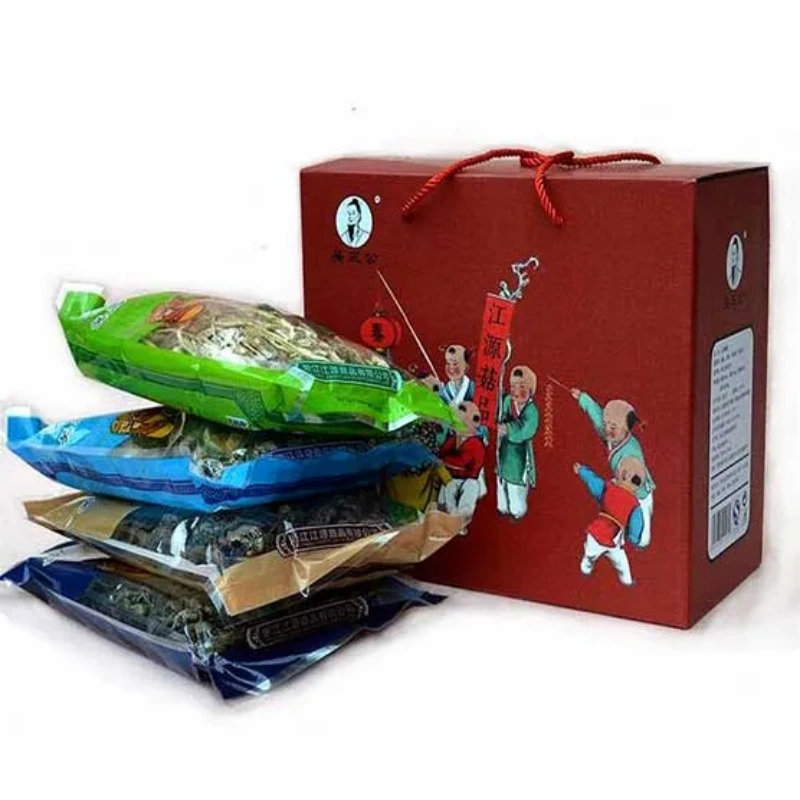
OEM Mushroom Packaging Manufacturer
OEM, or original equipment manufacturing, generally means producing goods to a buyer’s specifications. In the mushroom industry, however, the term can describe several different arrangements, and buyers should establish exactly what a supplier will deliver.
One company may grow and process mushrooms before packing them under a customer’s brand. Another may manufacture flexible packaging materials but have no mushroom-processing capabilities. A third may coordinate both services through qualified production partners.
These are not interchangeable business models.
OEM vs. ODM vs. Private Label
OEM projects typically begin with a buyer’s product and packaging specifications. ODM arrangements may involve a supplier’s existing product design or development input. Private-label supply focuses on selling products under the buyer’s brand, often using agreed formulations, grades, and packaging designs.
For a supermarket chain, the priority may be a distinctive retail pouch with approved artwork and consistent product grading. A food processor purchasing dried shiitake in bulk may care more about standardized cut sizes, moisture specifications, batch identification, and efficient handling.
The purchasing brief should reflect that difference.
Mushroom Manufacturing vs. Packaging Manufacturing
Before requesting samples, determine which stages the supplier actually controls.
A mushroom processor may handle raw-material selection, cleaning, grading, drying, inspection, and packing. Printed film production, pouch conversion, label printing, and carton manufacturing may be performed by separate specialist companies.
That arrangement is not automatically a disadvantage. What matters is transparent responsibility, documented specifications, and effective quality control across the supply chain.
Based on our experience with mushroom supply-chain requirements, product quality and packaging decisions need to be evaluated together. A well-printed package cannot compensate for inconsistent raw materials, and a carefully graded mushroom product can still lose commercial value if the packaging fails during storage or transportation.
For buyers evaluating an OEM mushroom packaging manufacturer in China, ask who approves the packaging material, who verifies its food-contact suitability, who controls artwork revisions, and who investigates defects if a shipment fails inspection.
Which Packaging Formats Suit Different Mushroom Products?
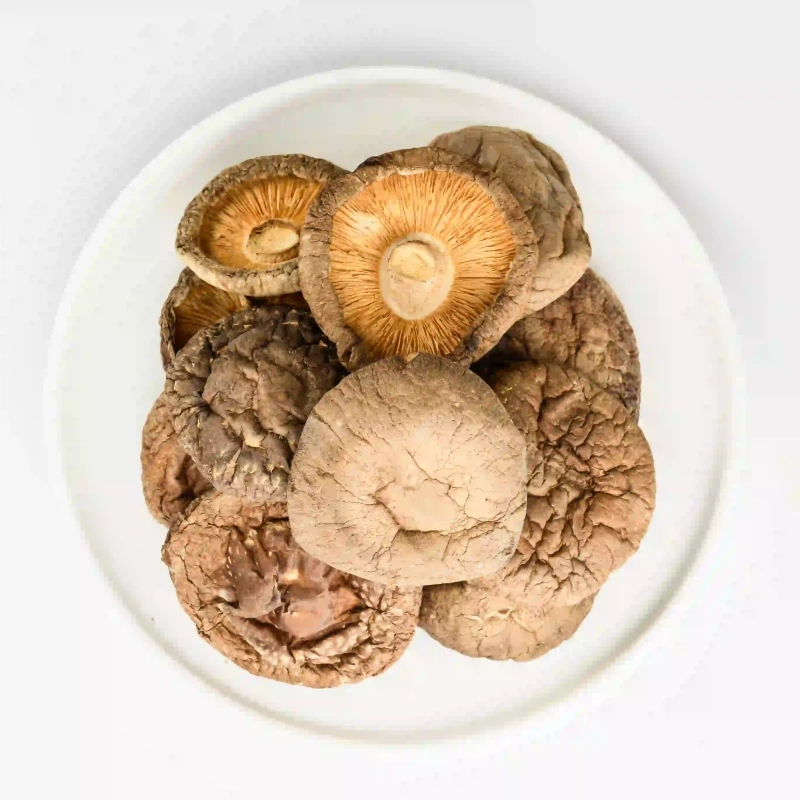
Mushroom Products
A packaging format should be selected according to the physical characteristics of the product and its intended distribution environment, not simply its appearance on a retail shelf.
Dried shiitake, fresh shiitake, black fungus, and mushroom powder have different requirements. Treating them as one packaging category creates unnecessary risk.
Packaging for Dried Shiitake Mushrooms
Dried shiitake is sensitive to moisture reabsorption. If the product absorbs moisture during storage, its texture and quality may deteriorate, while unsuitable conditions can increase spoilage risks.
The National Center for Home Food Preservation explains that dried foods should be cooled before packaging and protected from moisture and contamination during storage.
National Center for Home Food Preservation
Depending on the product specification and distribution conditions, buyers may consider sealed barrier pouches, suitable multilayer packaging, or food-grade bulk liners inside shipping cartons.
Vacuum packaging may be appropriate for certain products, but it should not be treated as a universal requirement. Material selection, sealing performance, product shape, and handling conditions all need assessment.
Packaging for Fresh Shiitake and Black Fungus
Fresh mushrooms present a different challenge. They continue to respire after harvest and are vulnerable to moisture loss, temperature abuse, and deterioration.
According to the University of California, Davis Postharvest Research and Extension Center, fresh mushroom storage requires careful temperature and humidity management. Its guidance also describes the role of perforated overwraps in maintaining suitable conditions.
Postharvest Research and Extension Center
A package suitable for dried shiitake may therefore be unsuitable for fresh mushrooms. Fresh-product packaging must account for ventilation, condensation, refrigeration, and the expected distribution period.
For black fungus, the first question is whether the product is fresh, dried, or processed. The answer changes the relevant packaging requirements.
Packaging for Bulk Ingredients and Mushroom Powder
Food manufacturers often prioritize predictable handling, efficient storage, and reliable batch identification over retail-facing design.
Whole dried mushrooms, sliced shiitake, broken pieces, and mushroom powder should have specifications that reflect their intended application. Powder, for example, requires particular attention to moisture exposure, dust containment, seal integrity, and the intended filling process.
The following matrix provides a starting point for supplier discussions. It is a selection framework, not a guarantee that any particular material will perform adequately.
| Product format | Potential packaging approach | Main evaluation criteria | Buyer priority |
|---|---|---|---|
| Whole dried shiitake | Sealed barrier pouch or lined bulk carton | Moisture protection, puncture resistance, product presentation | Quality retention |
| Sliced dried mushrooms | Barrier pouch or food-grade bulk liner | Moisture control, handling, consistent net weight | Processing efficiency |
| Fresh shiitake | Suitable ventilated retail pack or produce container | Airflow, condensation, refrigeration compatibility | Freshness management |
| Dried black fungus | Sealed pouch or bulk liner | Moisture protection, cleanliness, storage conditions | Consistency |
| Mushroom powder | Sealed, suitable barrier packaging | Seal integrity, moisture exposure, filling compatibility | Product stability |
How to Choose Materials for Mushroom Packaging
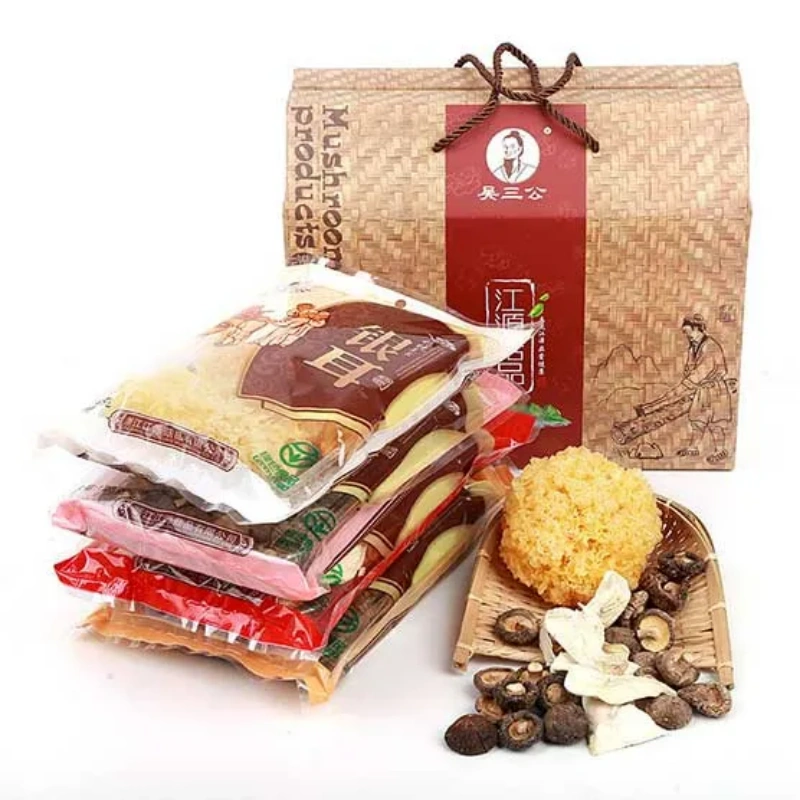
How to Choose Materials for Mushroom Packaging
Packaging material decisions should begin with measurable requirements rather than assumptions based on appearance or price.
Moisture and Oxygen Barrier Requirements
Two useful technical terms are water vapor transmission rate (WVTR) and oxygen transmission rate (OTR). WVTR measures water vapor transmission through a material under specified test conditions, while OTR measures oxygen transmission under specified conditions.
These values help buyers compare candidate materials, but they do not independently establish shelf life. Actual performance also depends on seals, packaging geometry, product condition, storage temperature, humidity, and distribution practices.
Request the relevant technical data for the proposed material and confirm that the testing conditions reflect the intended application.
Food-Contact Compliance and Documentation
Food-contact suitability is a separate requirement from packaging performance.
According to the European Commission’s food-contact materials guidance, materials placed on the EU market must comply with applicable safety requirements, including Regulation (EC) No 1935/2004 and relevant good manufacturing practice provisions. Specific requirements also depend on the material category.
Buyers importing into the United States or European Union should identify the intended market, packaging composition, conditions of use, and documents required for the specific material. Do not assume that a generic food-grade statement proves compliance with every destination market’s rules.
The commercial objective is straightforward: approve the product, packaging material, and compliance documentation as one coordinated specification before committing to a production order.
How to Verify an OEM Mushroom Supplier in China
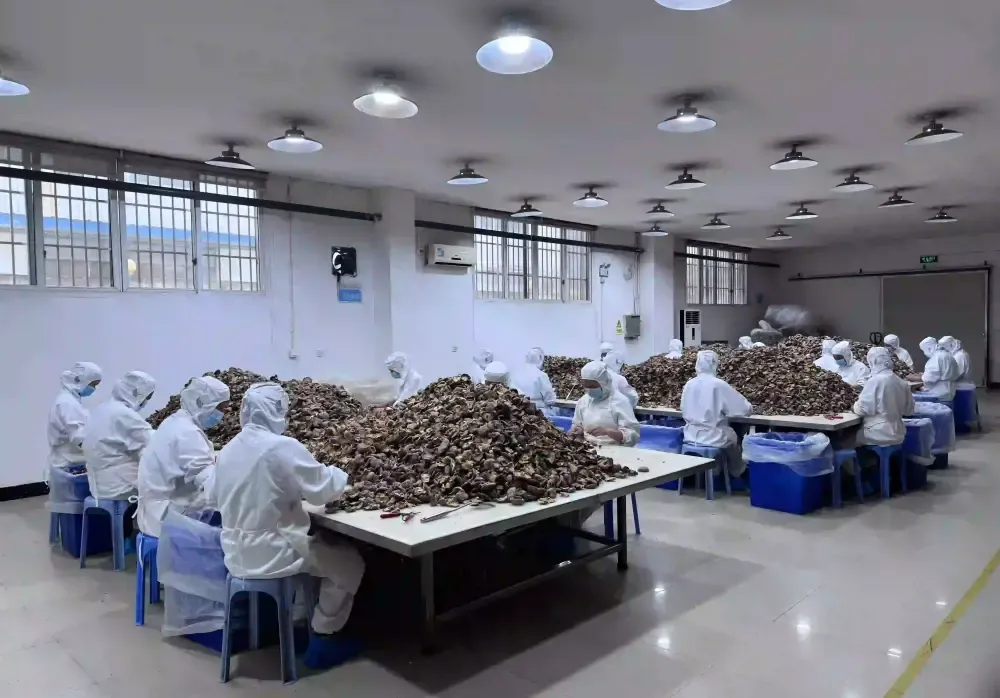
OEM Mushroom Supplier
A supplier’s website can introduce its capabilities, but procurement decisions should rest on verifiable evidence. Before approving an order, establish who controls the mushroom processing, who supplies the packaging, and who is responsible for the finished product’s conformity.
Quality Assurance: What Buyers Should Check
| Quality dimension | Evidence to request | Warning sign |
|---|---|---|
| Product consistency | Written grade, size, moisture, and appearance specifications where applicable | Product descriptions without measurable acceptance criteria |
| Packaging materials | Material specification, intended-use declaration, and relevant test reports | A generic “food-grade” claim with no supporting documentation |
| Sealing performance | Seal inspection criteria and appropriate package integrity tests | No defined method for checking defective seals |
| Traceability | Batch identification and records linking product lots to shipment documents | No reliable way to identify the affected batch |
| Label accuracy | Approved artwork, ingredient information where applicable, net quantity, and origin details | Uncontrolled artwork changes or unverified label claims |
| Production control | Inspection records, corrective-action procedures, and documented responsibilities | No clear process for handling nonconforming goods |
| Export readiness | Destination-specific documentation checklist and shipping records | Promises of universal compliance without identifying the market |
The precise tests and documents depend on the material, product, and destination. For example, the European Commission identifies Regulation (EC) No 1935/2004 as the general framework for food-contact materials and Regulation (EC) No 2023/2006 as the applicable good manufacturing practice framework. Plastic packaging can also fall under specific requirements, including Regulation (EU) No 10/2011 and subsequent amendments. Buyers should verify the current rules for their exact packaging construction.
Control the Sample-to-Production Transition
An approved sample is useful only when the commercial order follows the same documented specification. Before mass production, confirm the product grade, net weight, packaging material, dimensions, closure method, printed artwork, and labeling details.
Changes should be reviewed rather than accepted informally. A substitution in packaging film, for instance, may affect barrier performance or sealing behavior even when the new material looks identical.
For WUSANGONG, buyers should request confirmation of which controls are performed directly by the company and which depend on external packaging suppliers. This distinction makes responsibilities clearer if a quality issue arises after shipment.
OEM Mushroom Packaging MOQ, Costs, and Lead Times
There is no reliable universal MOQ or lead time for customized mushroom packaging. The figures depend on the product, packaging format, printing method, material availability, order size, and approval process.
Ask suppliers to separate the cost of the mushrooms from the cost of the packaging. A project may have one minimum order for the food product and another for custom-printed pouches, labels, or cartons. Sampling, printing plates or cylinders, tooling, and freight may also affect the landed cost.
A practical quotation request should specify:
- Mushroom type, grade, cut, and required quantity.
- Retail pack size or bulk packaging configuration.
- Target market and required compliance documentation.
- Printing requirements, artwork status, and barcode needs.
- Sample approval expectations and requested delivery window.
Compare quotations on an equivalent basis. A cheaper pouch is not necessarily the better option if its barrier performance is unsuitable, its print setup costs are excluded, or its minimum order leaves the buyer with excessive unused inventory.
The OEM Mushroom Packaging Process: From Brief to Shipment
A structured workflow reduces avoidable delays and makes supplier performance easier to evaluate.
- Define the product: Confirm whether the order involves dried shiitake, fresh mushrooms, black fungus, or mushroom powder.
- Set packaging requirements: Agree on format, dimensions, barrier properties, labeling, and intended distribution conditions.
- Review the quotation: Separate product costs, packaging costs, setup charges, and logistics.
- Approve samples and artwork: Confirm the physical sample and final label design before production.
- Verify production quality: Establish inspection criteria, batch identification, and procedures for handling defects.
- Check shipment documentation: Confirm that product records, packaging documentation, and import requirements are complete.
Why Consider WUSANGONG for Mushroom OEM Supply?
WUSANGONG’s business is rooted in Qingyuan, Zhejiang, a region associated with China’s shiitake mushroom heritage. Its product focus includes dried shiitake, fresh shiitake, black fungus, and other edible mushroom products.
For overseas buyers, the potential value lies in connecting mushroom sourcing and processing with customized product specifications and packaging coordination. Whether the project involves retail-ready dried shiitake or bulk ingredients for food manufacturing, the first step is to establish a clear specification and confirm the available production scope.
Buyers should request relevant quality documentation, discuss packaging options for their target market, and verify whether printing and packaging conversion are handled internally or by external partners. Any certification or compliance claim should be checked against current supporting records.
Frequently Asked Questions
- What is the MOQ for OEM mushroom packaging in China?
There is no single MOQ that applies to every project. Minimums depend on mushroom quantity, packaging format, printing method, and supplier requirements. Request separate minimums for the food product and customized packaging before comparing quotations.
- Can a mushroom supplier provide private-label packaging for supermarkets?
Potentially, yes. Buyers should confirm available pack formats, printing capabilities, artwork approval procedures, barcode requirements, and the supplier’s ability to meet retailer-specific labeling and documentation requirements.
- What packaging is best for dried shiitake mushrooms?
A sealed package with suitable moisture-barrier properties is often a starting point. The final choice depends on product moisture, storage conditions, transport duration, pack size, and the required shelf life. Validate the complete packaging system rather than relying on material descriptions alone.
- What documents should importers request from an OEM mushroom supplier?
Depending on the market and product, relevant documents may include product specifications, batch traceability records, applicable food safety documentation, packaging material declarations, and supporting compliance or migration test reports. EU requirements vary by material category, so buyers should confirm the current rules for the specific packaging construction.
- How long does private-label mushroom production take?
Lead time depends on raw-material availability, packaging procurement, artwork approval, production scheduling, inspection, and shipping arrangements. Obtain a project-specific schedule with separate milestones for sampling, packaging production, finished-goods inspection, and dispatch.
Expert Verdict
Choose an OEM partner that can demonstrate product consistency, transparent production responsibilities, and documented packaging suitability. The best sourcing decision is not the lowest quotation; it is the supplier whose specifications, quality controls, and delivery commitments can be verified before the order is placed.
References: