For commercial food processors and overseas importers, the debate between winter shiitake vs flower mushroom is not a matter of distinct botanical species, but an operational trade-off between structural density, rehydration yields, and cost-per-kilogram. Both originate from the same macrofungi (Lentinula edodes). However, flower mushroom (Huagu) is the cold-season microclimatic phenotype of winter shiitake (Donggu), commanding a 35% to 65% market price premium due to its climate-dependent fissure patterns and concentrated dry-matter content.
| Commercial Parameter | Winter Shiitake (Donggu) | Flower Mushroom (Huagu) | Procurement Decision Impact |
|---|---|---|---|
| Cuticle Morphology | Smooth, uniform dark-brown to russet pileus | Distinct radial fissures exposing white/cream internal context | Visual grading determinant for retail gift packs vs. diced ingredients |
| Cap Thickness | 8 mm–15 mm (Dense, flat-to-convex) | 15 mm–28 mm (Sub-globose, highly thickened) | Directly dictates slicing yield and chewiness in retort pouch meals |
| Rehydration Ratio (w/w) | 1:4.0 to 1:4.8 | 1:5.2 to 1:6.2 | Flower mushroom yields higher drained weight post-soak |
| Bulk Density (Dried) | 180–220 g/L | 240–310 g/L | Impacts ocean freight packaging efficiency and container cube utilization |
| Wholesale Price Index | Baseline (1.0x) | 1.35x–1.65x | Primary driver for ingredient cost engineering |
Enterprise buyers routinely face grading fraud and shipment rejections at customs: lower-grade autumn harvests treated with rapid thermal shock to simulate surface cracks, or bulk lots carrying moisture levels above 13%, triggering mold proliferation during transoceanic transit. Based on our experience with more than two decades of bulk shipments to Europe, Japan, and North America, authentic product evaluation requires looking past cosmetic sorting and inspecting cell-wall density, moisture activity, and chemical traceability back to certified cultivation bases.
1. Botanical Origin and Terroir: The Mechanism of Phenotypic Differentiation
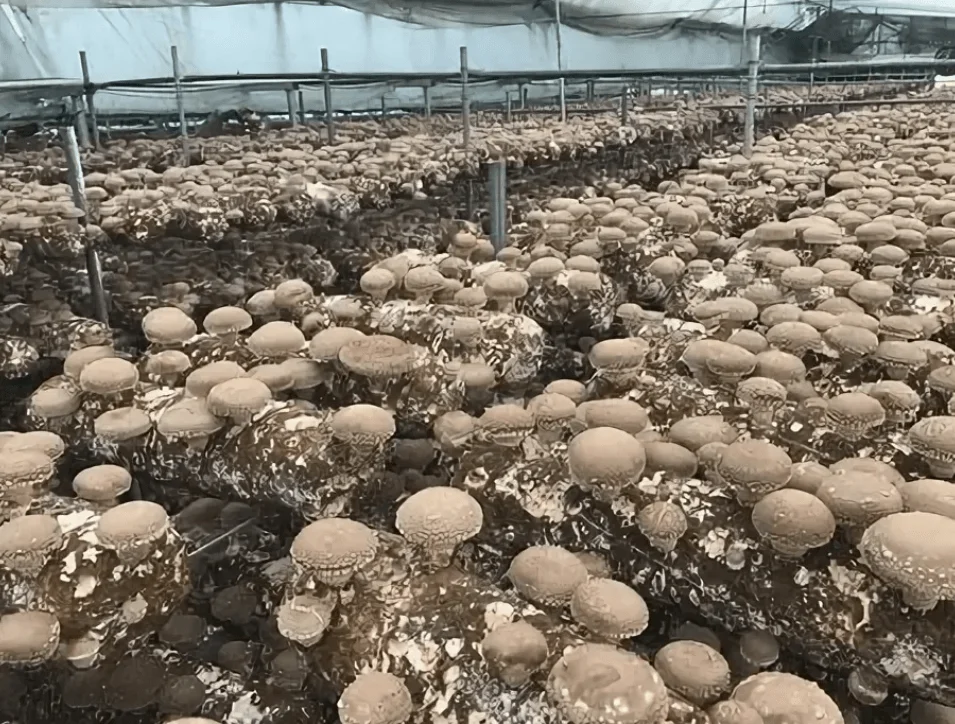
father of shiitake cultivation
The Microclimatic Cuticle Fissuring Mechanism
Flower mushrooms do not grow from specialized genetic strains. They develop exclusively when a standard winter-fruiting Lentinula edodes mycelium encounters an abrupt environmental stress event during the primordial button phase:
Environmental Trigger
Cold mountain air drops relative humidity below 60% with ambient temperatures below 10°C.
Cuticle Arrest
The outer pileus surface dehydrates rapidly, hardens, and halts its outer growth.
Substrate Activity
Sub-surface log or substrate temperatures remain buffered, allowing internal hyphae to continue absorbing water and nutrients.
Biomass Expansion
Internal fungal biomass expands outward against the rigid exterior shell.
Radial Fracturing
The outer surface fractures radially, creating the distinct “flower” pattern and exposing the dense white interior tissue.
White Flower Mushroom (Baihua)
Induced by sustained cold, dry weather with continuous diurnal temperature swings exceeding 12°C. Fissures are deep, broad, and starkly white, covering over 60% of the cap surface.
Tea Flower Mushroom (Chahua)
Occurs under intermittent cold winds and moderate humidity fluctuations. Fissures are finer, shallower, and interspersed with pale tan margins.
Smooth Winter Shiitake (Donggu)
Matures under steady, humid cold-temperature conditions (8°C to 14°C, relative humidity above 75%). The cuticle remains intact, producing a uniform, thick, and velvety cap.
Terroir Advantage: Qingyuan Protected Geographical Indication (GI)
The industrial performance of these fungi depends on agricultural terroir. In Qingyuan, Zhejiang — formally recognized under the EU-China bilateral agreement on Geographical Indications (GI) and home to an 800-year continuous mushroom cultivation heritage — high mountain topography provides the microclimates essential for authentic winter growth.
Cultivated at elevations exceeding 800 meters, Qingyuan dried shiitake benefits from unpolluted mountain water supplies and broadleaf hardwood substrates (Cyclobalanopsis and Castanopsis woods). According to agro-meteorological records across Zhejiang production zones, high-elevation Qingyuan farms average 180 frost days annually with intense UV exposure. This environment forces the mycelium to synthesize higher concentrations of defensive structural carbohydrates, yielding thick, fibrous cell walls that do not collapse into mush during commercial thermal processing.
2. Technical Comparison Matrix: Winter Shiitake vs. Flower Mushroom
Food manufacturing procurement requires precise physical and chemical metrics rather than subjective culinary descriptors. The structural differences between smooth winter shiitake and cracked flower mushrooms dictate mechanical slicing performance, rehydration kinetics, and the concentration of sensory compounds.
Smooth Winter Shiitake Structural Profile
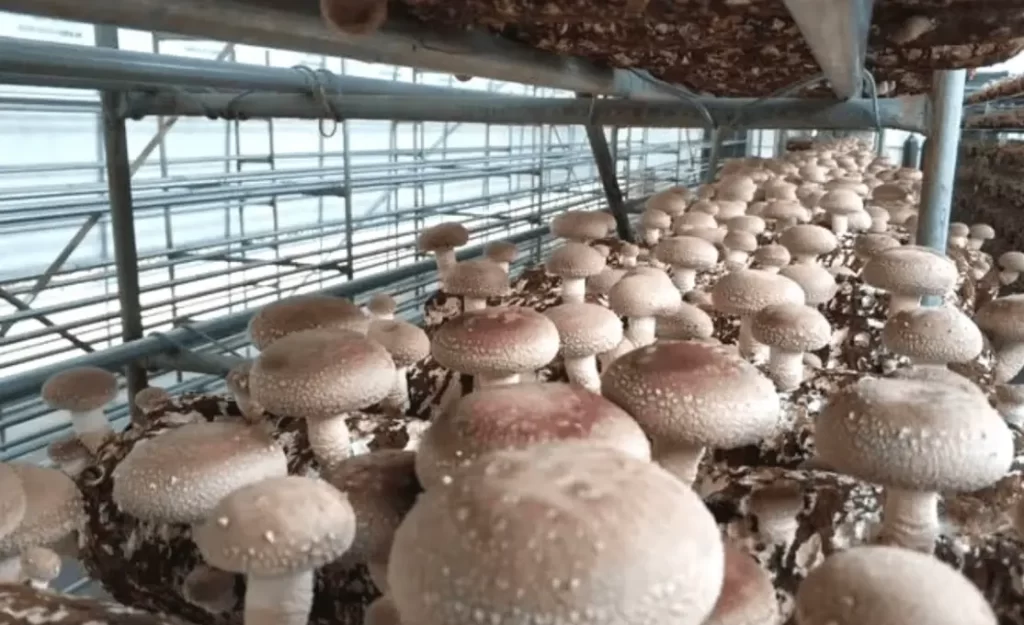
winter shiitake
Uniform, compact surface cuticle (8 mm to 15 mm thickness) with moderate hyphal density throughout the interior context.
Cracked Flower Mushroom Structural Profile
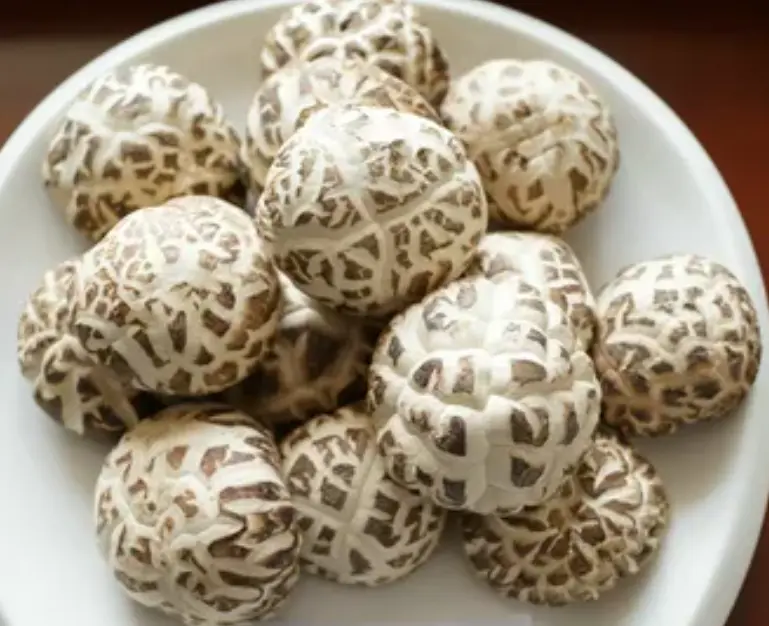
flower mushroom
Deep physical fissures exposing white internal context, backed by an ultra-dense, slow-grown pileus (15 mm to 28 mm thickness).
The table below outlines raw technical parameters verified under ISO and standard trade testing methods:
| Technical Metric | Smooth Winter Shiitake (Donggu) | Tea Flower Mushroom (Chahua) | White Flower Mushroom (Baihua) | Test Standard/Analytical Method |
|---|---|---|---|---|
| Cap Diameter Sizing | 20–30 mm, 30–40 mm, 40–50 mm, 50 mm+ | 30–45 mm, 45–55 mm, 55 mm+ | 30–45 mm, 45–55 mm, 55 mm+ | Calibrated Mechanical Sieve Sizing |
| Cap Thickness (Dried) | 8.0–14.5 mm | 14.0–20.0 mm | 18.0–28.0 mm | Digital Vernier Caliper (Central Pileus) |
| Moisture Content | ≤ 12.0% | ≤ 11.5% | ≤ 11.0% | ISO 712/Karl Fischer Titration |
| Water Activity (aw) | < 0.60 | < 0.55 | < 0.52 | Chilled-Mirror Dewpoint (25°C) |
| Full Rehydration (20°C) | 90–120 minutes | 180–240 minutes | 240–360 minutes | Immersion Gravimetric Method |
| Rapid Rehydration (60°C) | 30–45 minutes | 60–75 minutes | 75–90 minutes | Heated Agitation Tank Method |
| Rehydration Yield (w/w) | 1:4.2 to 1:4.8 | 1:5.0 to 1:5.6 | 1:5.5 to 1:6.2 | Post-Drain Weight Measurement (Drained 5 min) |
| Shear Force Resistance | 22.4 ± 2.1 N | 28.6 ± 2.5 N | 35.8 ± 3.2 N | Texture Analyzer (50% Compression, Post-Cook) |
| Total Beta-Glucans | 28.5–33.2 g/100g | 31.0–36.5 g/100g | 34.2–41.8 g/100g | Enzymatic Assay (Megazyme Method) |
| Free Glutamic Acid | 1,150–1,420 mg/100g | 1,320–1,580 mg/100g | 1,450–1,780 mg/100g | High-Performance Liquid Chromatography (HPLC) |
| Guanylate (5′-GMP) | 180–240 mg/100g | 220–285 mg/100g | 260–340 mg/100g | Ion-Exchange Chromatography |
| Extraneous Matter/Debris | <0.1% | <0.05% | <0.02% | Visual Manual Inspection/Optoelectronic Sort |
Rehydration Kinetics and Industrial Drained Yields
For commercial kitchens and processed meal facilities, rehydration dynamics translate directly to factory throughput and batch costs.
Because flower mushrooms develop slowly in sub-zero winter spells, their hyphae form a tightly packed, highly crystalline cellular matrix. When dry, they absorb water slower than smoother, lighter grades:
Rehydration Speed Hierarchy: Smooth Winter Shiitake is faster than Tea Flower, which is faster than White Flower.
However, their total absorption capacity is significantly higher. According to third-party processing trials on commercial production lines, White Flower mushroom yields an average drained weight of up to 6.2 kg from a single kilogram of dried input, compared to 4.5 kg from smooth winter shiitake.
For industrial canning, ready-meal retorting, and high-pressure processing, flower mushrooms preserve cell-wall integrity without weeping water into surrounding sauces. Smooth winter shiitake, on the other hand, hydrates faster — saving batch prep time in fast-turnaround instant seasoning pastes, dry soup mix blending, and high-speed food service operations where long soaking times introduce process bottlenecks.
3. Industrial Processing & Drying Mechanics: Protecting Bioactive Integrity
The transformation of freshly harvested winter shiitake into shelf-stable commercial dried stock requires strict dehydration engineering. In the global trade, an unstandardized drying curve ruins valuable winter crops by caramelizing free sugars, destroying umami-bearing ribonucleotides, or locking moisture deep within thick caps.
Industrial drying follows a strict, multi-stage thermal progression over an 18 to 22-hour cycle:
Stage 1 (35°C–40°C)
Gentle surface moisture evaporation prevents case hardening and skin blistering.
Stage 2 (42°C–50°C)
Endogenous enzyme activation drives lentinan and guanylate synthesis while initial moisture clears.
Stage 3 (52°C–58°C)
Deep cap core dehydration drives water out of dense, thick context tissues.
Stage 4 (60°C–65°C)
Final moisture stabilization locks water content safely at or below 12.0% for aseptic preservation.
The Pitfalls of Traditional Sun-Drying
While legacy culinary narratives champion open-air sun-drying, this method is unacceptable for modern industrial-scale supply chains:
Food Safety Hazards
Open-air drying exposes product to airborne particulates, bird droppings, insect oviposition, and environmental mold spores (Aspergillus species).
Inconsistent Residual Moisture
Solar drying cannot uniformly dry thick flower mushroom caps (which measure 20 mm or thicker), leading to internal moisture pockets (aw > 0.65) that trigger rot during multi-week ocean transit.
Uncontrolled Enzymatic Degradation
Variable outdoor drying rates cause erratic browning and premature degradation of free glutamates.
Modern Closed-Loop Heat Pump Dehydration
To meet international export criteria, processing must occur in automated, clean-energy heat pump tunnel dryers.
Based on our experience with automated drying facilities in Qingyuan, a multi-stage thermal cycle over 18 to 22 hours yields the highest structural integrity. Starting at 35°C to avoid case hardening (surface crusting that traps moisture inside), the temperature is gradually stepped up to 60°C. This activates endogenous enzymes that maximize 5′-guanosine monophosphate (5′-GMP) synthesis while driving final moisture content reliably below 12.0%.
For clients requiring elevated Vitamin D2 specifications, dried caps undergo secondary, controlled ultraviolet (UV-B) photolytic irradiation inside cleanroom environments. This process safely bio-converts natural fungal ergosterol into active Vitamin D2 without exposing the mushrooms to outdoor contaminants.
4. International Regulatory Compliance and Food Safety Assurance
Because Lentinula edodes accumulates minerals from its substrate, enterprise buyers face strict customs scrutiny. Mitigating the risk of customs detention under European RASFF alerts or US FDA Import Alerts requires strict verification of contaminant limits before purchase contracts are executed.
Our Supply Chain Follows a Verifiable Farm-to-Container Quality Protocol
Sustainably Managed Qingyuan Forestry Substrate
↓
GAP-Certified Cultivation Base
↓
Clean Tunnel Drying Facility
↓
Multi-Channel Optical Sorting
↓
Batch-Specific Pre-Shipment Testing.
The table below details statutory chemical, heavy metal, and microbiological thresholds across primary export territories:
| Compliance Parameter | European Union (EU Reg 2023/915 & 396/2005) | United States (US FDA BAM & Action Levels) | Japan (MHLW Positive List System) | Jiangyuan In-House Export Release Standard Testing Protocol |
|---|---|---|---|---|
| Cadmium (Cd) | ≤ 1.0 mg/kg | ≤ 1.0 mg/kg | ≤ 1.0 mg/kg | ≤ 0.5 mg/kg ICP-MS |
| Lead (Pb) | ≤ 1.0 mg/kg | ≤ 0.5 mg/kg | ≤ 1.0 mg/kg | ≤ 0.3 mg/kg ICP-MS |
| Arsenic (As) | ≤ 1.0 mg/kg (Inorganic) | Compliance verification required | ≤ 1.0 mg/kg | ≤ 0.2 mg/kg AFS/ICP-MS |
| Sulfur Dioxide (SO2) | Non-detectable (<10 mg/kg) | ≤ 10 mg/kg (Exemption threshold) | ≤ 10 mg/kg | Zero-Tolerance (Sulfur-fumigation free) Monier-Williams Method |
| Pesticide Residues | Conformity to EU MRL (Carbendazim ≤ 0.1 mg/kg) | FDA Multi-Residue Screen (Zero unapproved chemistries) | Uniform Limit: 0.01 mg/kg | Full negative multi-residue screen (500+ compounds) GC-MS/MS & LC-MS/MS |
| Moisture Content | ≤ 12.0% | ≤ 13.0% | ≤ 12.0% | ≤ 11.5% Karl Fischer/Halogen Moisture Analyzer |
| Total Aerobic Count | <105 CFU/g | <105 CFU/g | <105 CFU/g | <104 CFU/g ISO 4833-1 |
| Salmonella spp. | Absent in 25g | Absent in 25g | Absent in 25g | Absent in 25g ISO 6579/FDA BAM Ch.5 |
| Escherichia coli | <10 CFU/g | <10 MPN/g | Absent | Absent in 1g ISO 16649-2 |
To guarantee compliance, Jiangyuan maintains single-lot traceability back to our GlobalG.A.P.-managed smallholder bases in Qingyuan. Every batch comes backed by full-panel COAs from ISO 17025-accredited labs (SGS or Eurofins), eliminating import border clearance risks.
5. Commercial Application Guide: Matching Grade to End Use
Purchasing efficiency depends on matching mushroom specifications to production line constraints:
Retail Presentation & Luxury Hospitality
White or Selected Tea Flower Mushroom (Grade A, 4–5 cm cap diameter).
Retort Pouch Meals & Canned Soups
Thick-Cap Smooth Winter Shiitake (whole caps or calibrated 3 mm to 5 mm machine-cut slices).
Commercial Seasonings & Soup Bases
Standard Smooth Winter Shiitake (calibrated 3×3 mm or 5×5 mm machine dicing).
Nutraceutical & Active Polysaccharide Extraction
Extraction-Grade Dense Winter Shiitake Cuts.
High-End Foodservice & Luxury Retail Packaging
Recommended Grade: White Flower (Baihua) or Selected Tea Flower (Chahua) Mushroom.
Size Spec: 3–4 cm or 4–5 cm uniform cap, stem trimmed to under 5 mm (Stemless Button).
Rationale: The high visual contrast between pale fissures and the rich brown cuticle provides maximum visual appeal in clear consumer packaging, holiday gift boxes, and banquet presentations.
Commercial Food Processing (Retort Pouch Meals, Instant Noodles, Canned Soups)
Recommended Grade: Standard Smooth Winter Shiitake (Donggu) or Machine-Sliced Strips (3 mm to 5 mm).
Rationale: Smooth winter shiitake hydrates 40% to 50% faster than flower mushrooms, cutting preparation hold times in processing plants. Its flatter cap profile feeds cleanly through continuous dicing machines with minimal debris. It also matches the umami performance of cracked mushrooms at a more competitive cost per metric ton.
Nutraceutical & Functional Food Extraction
Recommended Grade: Coarse Granulated or Extraction-Grade Thick Winter Shiitake Caps.
Rationale: Lentinan and immunomodulatory beta-glucan levels depend on cold-season fungal maturity, not exterior surface fissures. Paying a visual premium for cracked caps adds cost without increasing active extraction yields. High-density, clean-dried whole or broken winter caps yield identical bioactive fractions at substantially lower input costs.
6. Enterprise Procurement FAQs: Winter Shiitake vs. Flower Mushroom
Can suppliers artificially produce flower mushroom fissures to inflate grading?
Yes. Some vendors induce cracking in cheaper autumn or greenhouse mushrooms by blowing dry, hot air over moist buttons or using mechanical scoring. These simulated flower mushrooms have thin, fragile caps, shallow fissures, and loose cellular structures that turn soft upon rehydration. Genuine high-altitude Qingyuan winter flower mushrooms feature deep, natural crevices and thick, rounded caps that remain firm under cooking stress.
What is the primary cause of mold spoilage during ocean container shipping?
Moisture migration driven by thermal changes across maritime shipping corridors. If dried mushrooms are packed above 12% moisture in basic polyethylene bags, condensation forms inside the packaging when vessels pass through temperature swings. To prevent this, commercial shipments should require moisture content below 11.5%, along with multi-layer barrier foil bags or heavy cartons packed with desiccants.
Why does smooth winter shiitake often work better than flower mushroom in automated dicing lines?
Flower mushrooms have a rounded, convex profile and hard, variable context, which can cause them to bounce, slip, or crush unevenly in continuous rotary dicing machines. Smooth winter shiitake caps lie flatter, allowing uniform blade feeding and precise particulate cuts (such as 3×3 mm or 5×5 mm cubes) with minimal fines.
How does the rehydration liquid from flower mushrooms compare to smooth winter shiitake?
Because authentic flower mushrooms undergo extended, cold-climate growth cycles, their context stores higher levels of water-soluble amino acids and trehalose. When soaked under controlled conditions (below 20°C), the liquor from flower mushrooms exhibits higher specific gravity and clearer amber color, making it well-suited for reduction glazes, broths, and clear soups.
What documents are mandatory for clearing containerized dried shiitake through EU or US ports?
Importing dried edible fungi into the EU and US requires:
- Ocean Bill of Lading and Commercial Invoice/Packing List with precise HS Code classification (0712.39.10).
- Phytosanitary Certificate issued by official customs authorities (such as China Inspection and Quarantine).
- Certificate of Origin, including Protected Geographical Indication (PGI) status documentation where applicable.
- Batch-specific COA showing non-detectable sulfur dioxide (SO2 <10 mg/kg) and compliance with EU 2023/915 or US FDA heavy metal limits.
- Third-party GFSI audit benchmarks, including HACCP or ISO 22000 registration.
Expert Sourcing Verdict
When evaluating winter shiitake vs. flower mushroom, keep your decision framework simple:
Buy Flower Mushrooms (Huagu) when the mushroom is the visual hero of the dish — such as in retail glass-jar packaging, luxury meal kits, or traditional banquet catering where consumers judge value by cap thickness and cracking patterns.
Buy Smooth Winter Shiitake (Donggu) when processing mushrooms into retort sauces, canned preparations, frozen ready-to-eat meals, or functional extracts. It delivers the same umami compounds, identical fiber profiles, and faster hydration cycles — while saving 30% to 50% on ingredient input costs.
Direct partnership with primary processors in Qingyuan eliminates trading house markups, guarantees verifiable pesticide and heavy metal compliance, and ensures container-to-container consistency. Contact Jiangyuan Mushroom’s commercial supply desk to request custom size sorting, cut specifications, and export documentation for your upcoming purchasing cycle.
References:
U.S. FDA — Import Alert 25-05: Dried Fungus / Mushrooms
China Ministry of Commerce — Technical Guidelines for Exporting Shiitake Mushrooms